In the previous article, we looked at how a gas engine burns fuel gas to produce rotational power and drive a generator.
To understand the systems and major components of a gas engine, it is helpful to begin with the basic operating principles of an internal combustion engine and the sequence of the four-stroke cycle.
In this article, we will look at what an internal combustion engine is and how the piston, intake valve, and exhaust valve move during the four-stroke cycle of a power-generation gas engine.
Related article|What Is a Gas Engine? A Practical Introduction
1. What Is an Internal Combustion Engine?
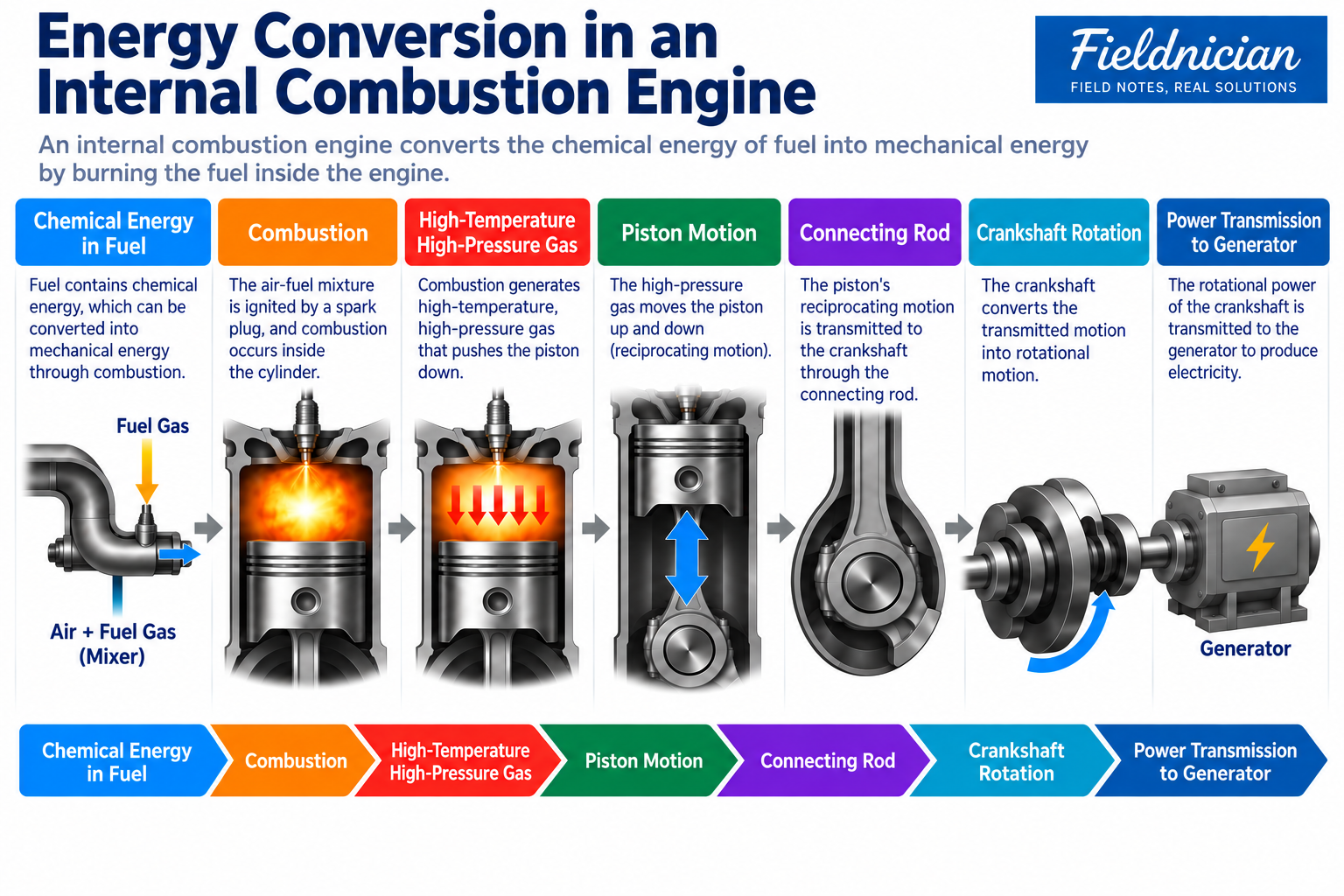
An internal combustion engine burns fuel inside the engine and converts the resulting energy into mechanical motion.
When combustion occurs, high-temperature, high-pressure gases are produced inside the cylinder. The pressure pushes the piston and creates reciprocating motion.
The piston’s movement is transmitted through the connecting rod to the crankshaft, which converts it into rotary motion.
Chemical energy in the fuel → Combustion → Cylinder pressure → Piston movement → Crankshaft rotation
In a power-generation gas engine, this rotational power is transmitted to a generator to produce electricity.
2. Is a Gas Engine an Internal Combustion Engine?
A gas engine is a type of internal combustion engine that can use gaseous fuels such as natural gas, biogas, and landfill gas.
Many spark-ignited gas engines used for power generation form a combustible mixture of fuel gas and air and initiate combustion with a spark from a spark plug.
A gasoline engine operates on a similar basic principle because it also uses a spark plug to ignite an air–fuel mixture.
A conventional diesel engine, however, compresses air to a high pressure and then injects fuel so that it ignites through the heat generated by compression.
Not all gas engines use the same structure or ignition method.
The point at which the mixture is formed, the method used to supply the fuel, and the way combustion is initiated may vary depending on the engine application, manufacturer, and fuel.
The combustion system of an actual engine should therefore be confirmed using the manufacturer’s technical information and the system diagram for that engine.
3. How Does a Four-Stroke Engine Work?
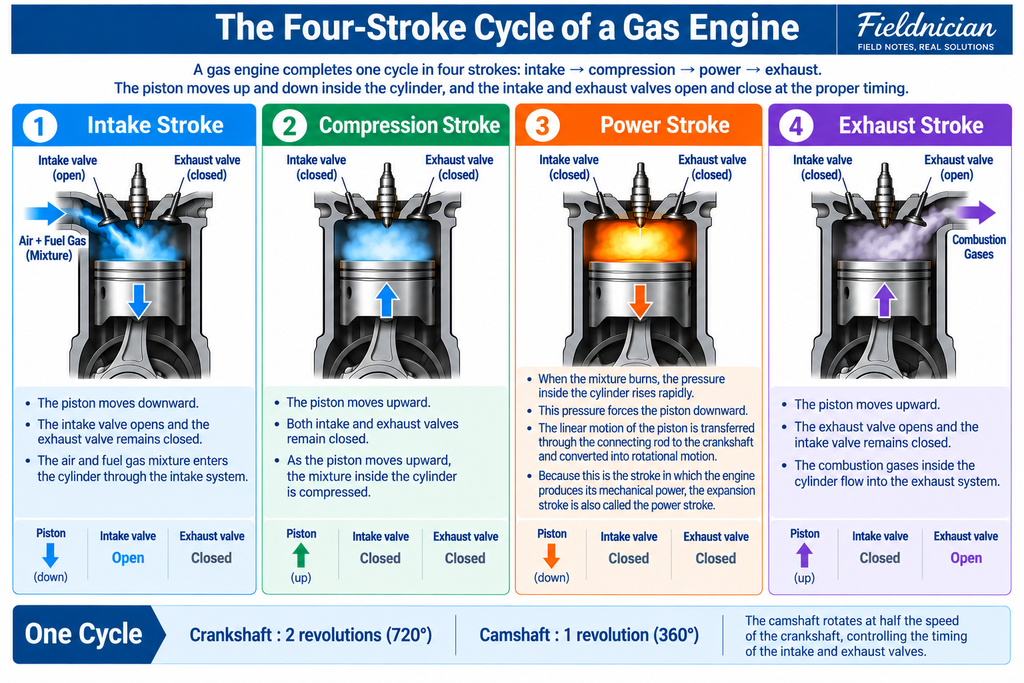
A four-stroke engine completes one combustion cycle through four separate strokes.
Intake → Compression → Power → Exhaust
During the intake stroke, air or an air–fuel mixture enters the cylinder.
During the compression stroke, the piston moves upward and compresses the air or mixture inside the cylinder.
During the power stroke, combustion pressure pushes the piston downward and produces useful mechanical power.
During the exhaust stroke, the combustion gases are discharged from the cylinder.
During one complete cycle, the piston moves downward twice and upward twice, while the crankshaft completes two full revolutions.
By continuously repeating these four strokes, the engine produces rotational power.
4. What Enters the Cylinder During the Intake Stroke?
During the intake stroke, the piston moves from near top dead center toward bottom dead center.
The intake valve opens and connects the cylinder to the intake system, allowing the air or mixture required for combustion to enter the cylinder.
Whether air or a premixed charge of fuel gas and air enters the cylinder depends on the engine’s fuel-supply system.
In the premixed gas engines I have worked with, the fuel gas and air were mixed before entering the cylinders.
The mixture then passed through the boosting and cooling processes before being supplied to each cylinder through the intake manifold.
The exhaust valve is generally closed during the main part of the intake stroke. However, the actual opening and closing times of the intake and exhaust valves do not necessarily coincide exactly with top dead center or bottom dead center.
The valves open and close according to the timing specified by the engine manufacturer as the cycle proceeds into the compression stroke.
Related article|How Do Fuel Gas and Air Enter a Gas Engine? (Coming Soon)
5. Why Is the Mixture Compressed?
During the compression stroke, the piston moves from near bottom dead center toward top dead center.
During the main part of the compression stroke, the intake and exhaust valves are closed, and the air or mixture inside the cylinder is compressed.
As the mixture is compressed, its pressure and temperature increase, creating the conditions required for ignition and combustion.
In a typical spark-ignited gas engine, the ignition system begins the combustion process near the end of the compression stroke.
Ignition timing is not fixed at the exact point when the piston reaches top dead center. It may be controlled according to engine speed, load, fuel gas condition, and intake conditions.
Effective compression also depends on the condition of the components that seal the combustion chamber, including the piston rings, cylinder liner, intake valve, and exhaust valve.
Related article|How Does a Gas Engine Ignition System Work? (Coming Soon)
Related article|Gas Engine Ignition Timing and the Role of Pickup Sensors (Coming Soon)
6. The Power Stroke Produces Engine Power
When the ignited mixture burns near the end of the compression stroke, the temperature and pressure inside the cylinder rise rapidly.
The resulting combustion pressure pushes the piston toward bottom dead center and produces useful engine power. For this reason, the expansion stroke is also called the power stroke.
The force acting on the piston is transmitted through the connecting rod to the crankshaft.
The crankshaft converts the piston’s linear reciprocating motion into rotary motion that keeps the engine rotating and drives the generator.
Gas engine output and combustion stability are affected by several factors, including fuel gas and air delivery, mixture condition, compression, and ignition timing.
Related article|How Do the Connecting Rod and Crankshaft Work? (Coming Soon)
7. The Exhaust Stroke Removes Combustion Gases
As the power stroke approaches its end, the exhaust valve begins to open, and the piston moves upward from near bottom dead center toward top dead center.
As the piston rises, the combustion gases move through the exhaust valve and into the exhaust system.
The exhaust gas flow may be used to drive a turbocharger. Depending on the installation, some of the remaining exhaust heat may also be recovered.
Restricted exhaust flow can affect gas exchange inside the cylinder and influence the next combustion cycle.
The actual opening and closing times of the exhaust valve do not necessarily coincide exactly with top dead center or bottom dead center.
When the exhaust stroke ends, the intake process begins again and the same cycle is repeated.
Related article|How Does a Gas Engine Turbocharger Work?
Related article|Where Does the Heat from a Gas Engine Go? Understanding Heat Recovery in CHP Systems
8. The Crankshaft and Camshaft Rotate at Different Speeds
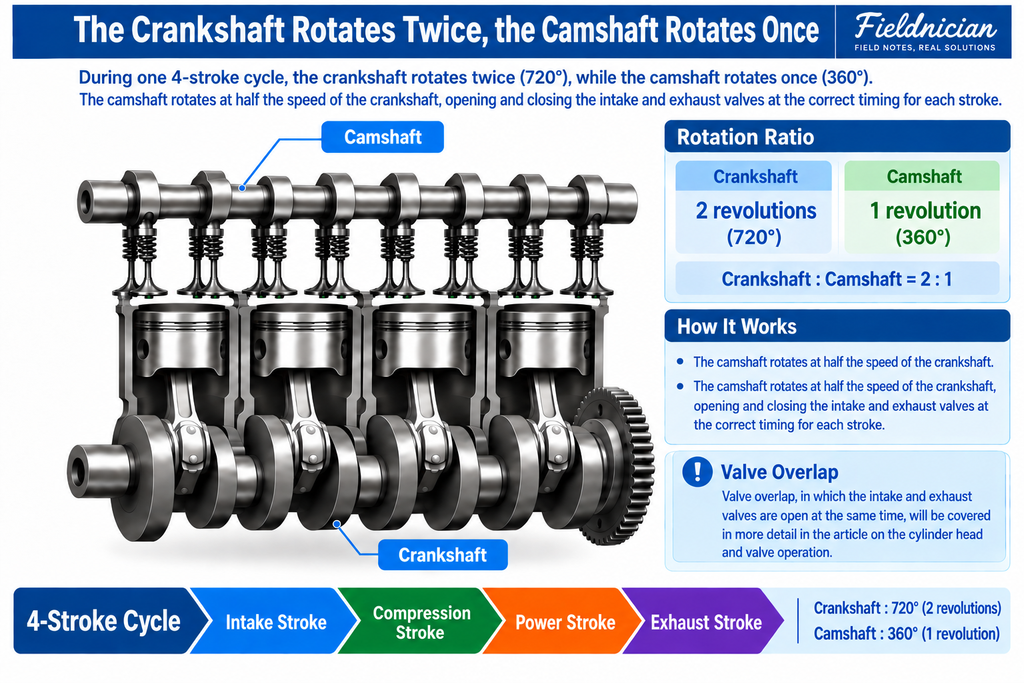
During one complete four-stroke combustion cycle, the crankshaft rotates twice, or 720 degrees.
During the same period, the camshaft that controls the intake and exhaust valves rotates once, or 360 degrees.
Crankshaft : Camshaft = 2 : 1
The camshaft rotates at half the speed of the crankshaft and operates the valve train according to each stage of the four-stroke cycle.
If the relationship between the crankshaft and camshaft is incorrect, the valves may not open and close at the correct points in the piston cycle.
This can interfere with the intake and exhaust processes and affect engine output and combustion stability. Depending on the engine design and the extent of the timing error, it may also result in mechanical damage.
The condition of the valve train, valve clearance, and valve timing are therefore important inspection items.
Related article|How Do a Gas Engine Cylinder Head and Its Intake and Exhaust Valves Work? (Coming Soon)
9. How Do Multiple Cylinders Deliver Power?
In a multicylinder engine, all cylinders do not perform the same stroke at the same time.
Each cylinder proceeds through a different part of the four-stroke cycle, and the power strokes occur in a specified sequence to deliver rotational force to the crankshaft.
The sequence in which combustion begins in the cylinders is called the firing order.
The firing order is determined by factors such as the cylinder arrangement and crankshaft design. It can also affect engine vibration and rotational stability.
When inspecting the ignition system or valve train, the cylinder numbers, firing order, and crankshaft position must be identified correctly.
Because the cylinder numbering and firing order vary among engines, the manufacturer’s technical information should always be followed.
10. Why Is the Four-Stroke Cycle Important in the Field?
When a problem occurs in a gas engine, the four-stroke sequence can be used to identify whether the change began during the intake, compression, combustion, or exhaust process.
A problem in the intake system may prevent enough air or mixture from entering the cylinder.
Changes in the condition of the piston rings, cylinder liner, or valves can affect cylinder compression.
If ignition and combustion do not occur correctly, cylinder output, exhaust gas temperature, and knock data may change.
Problems with the intake or exhaust valves or the exhaust system can interfere with gas exchange inside the cylinder.
Instead of examining only the component most closely associated with an alarm, it is better to follow the four-stroke sequence and compare the related systems and operating data.
Understanding the basic operating sequence makes it easier to identify which process changed and how that change affected the other engine systems.
Conclusion
An internal combustion engine burns fuel inside the engine to produce reciprocating piston motion and converts that motion into crankshaft rotation.
In a four-stroke gas engine, the intake, compression, power, and exhaust strokes are repeated continuously.
During one complete cycle, the crankshaft rotates twice while the camshaft rotates once, coordinating the movement of the pistons and valves.
Whether air or a premixed air–fuel charge enters the cylinder, and how combustion is initiated, depends on the engine design.
Understanding the four-stroke cycle provides a foundation for understanding the fuel, intake, and ignition systems, as well as the operation of the valves, pistons, connecting rods, and crankshaft.