In the previous article, we looked at how the intake, compression, power, and exhaust strokes are repeated in a gas engine.
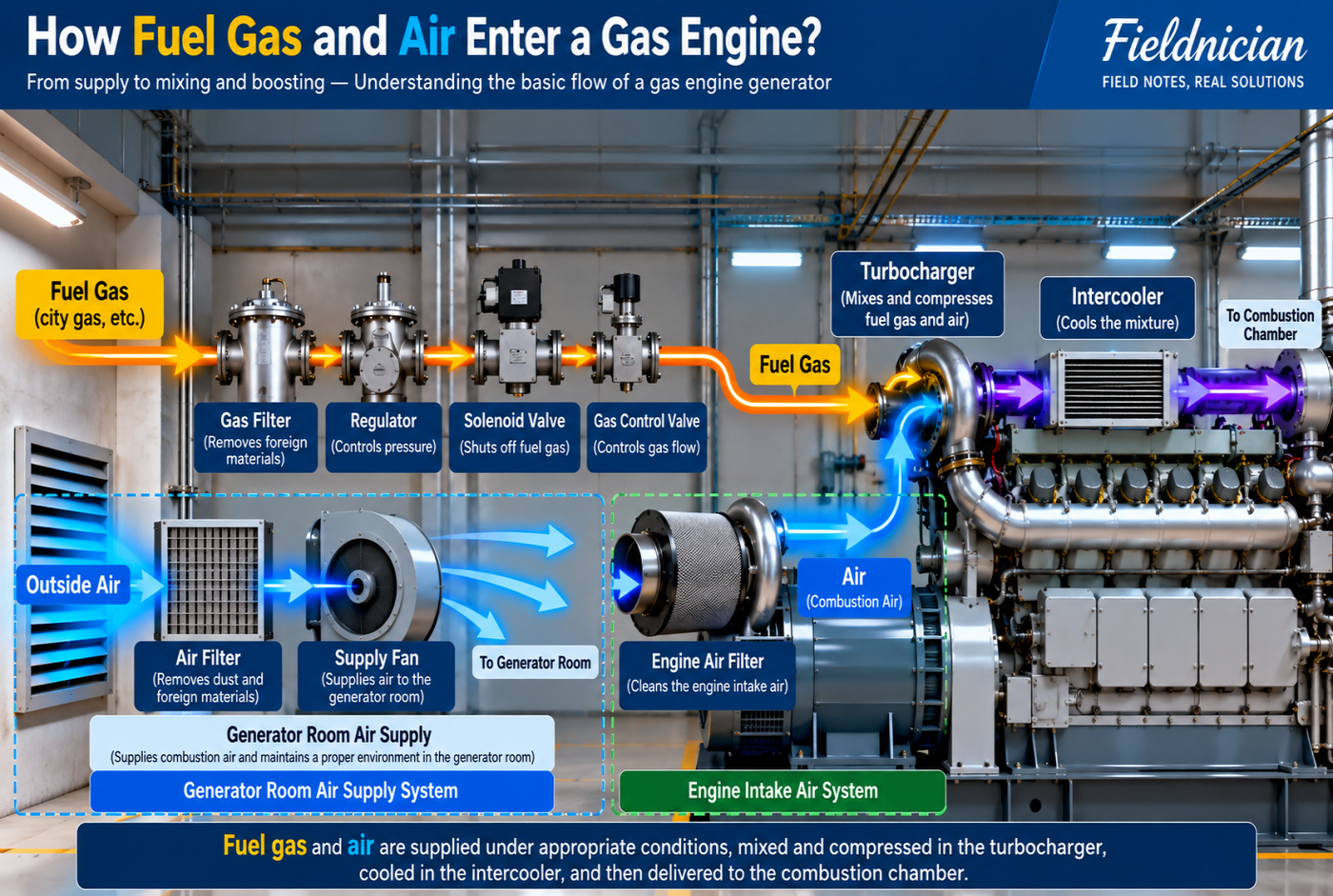
For combustion to occur, fuel gas and air must be supplied to the cylinders under suitable conditions.
Fuel gas travels to the engine through the site gas supply system and the gas train.
Depending on the installation, combustion air may enter through the engine room or be supplied directly through a dedicated outside-air intake duct before passing through the engine intake system.
The point at which fuel gas and air are mixed—and whether mixing takes place before or after turbocharging—varies with the engine design.
In this article, we will look at the separate paths taken by fuel gas and air, where they are mixed, and how the resulting mixture reaches the cylinders.
Related article|What Is an Internal Combustion Engine? How a Four-Stroke Engine Works
1. Fuel Gas and Air Enter Through Different Paths
Fuel gas and air do not enter the engine through the same piping from the beginning.
Fuel gas passes through the site gas supply system, where its pressure and supply conditions are adjusted, and then travels through the gas train toward the engine.
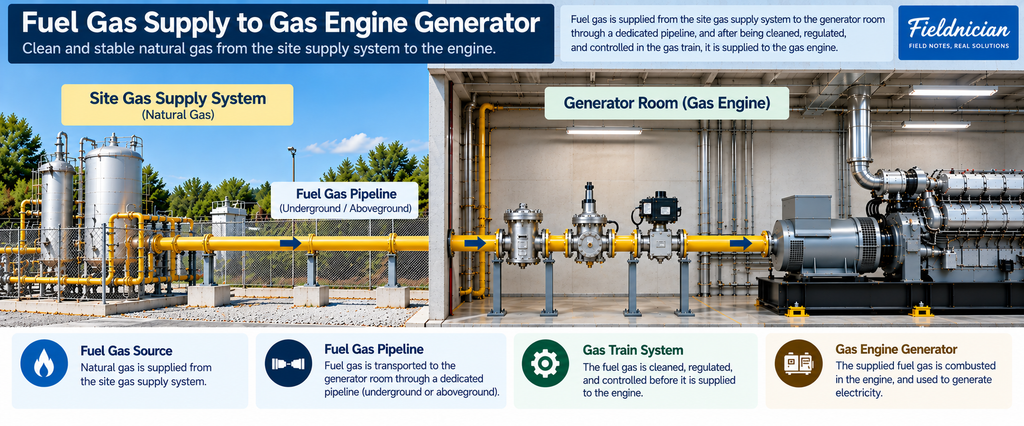
Air may enter through the engine-room air-supply system or a dedicated outside-air intake duct. It then passes through the engine air filter and intake piping before reaching the engine.
The two basic paths can be summarized as follows:
Fuel gas source
→ Site gas supply system
→ Gas train
→ Mixing point or engine
Outside air
→ Engine-room air supply or dedicated intake duct
→ Engine air filter
→ Intake system
→ Mixing point or engine
After travelling through their separate systems, the fuel gas and air are mixed at a point determined by the engine design.
Because the actual supply paths and component arrangements vary among engines and installations, both the fuel-gas and air-intake system diagrams should be checked.
2. How Does Fuel Gas Reach the Engine?
Fuel gas passes through the site gas supply system and is adjusted to the pressure and conditions required by the engine.
It then travels through the gas train before reaching the mixing point or the engine.
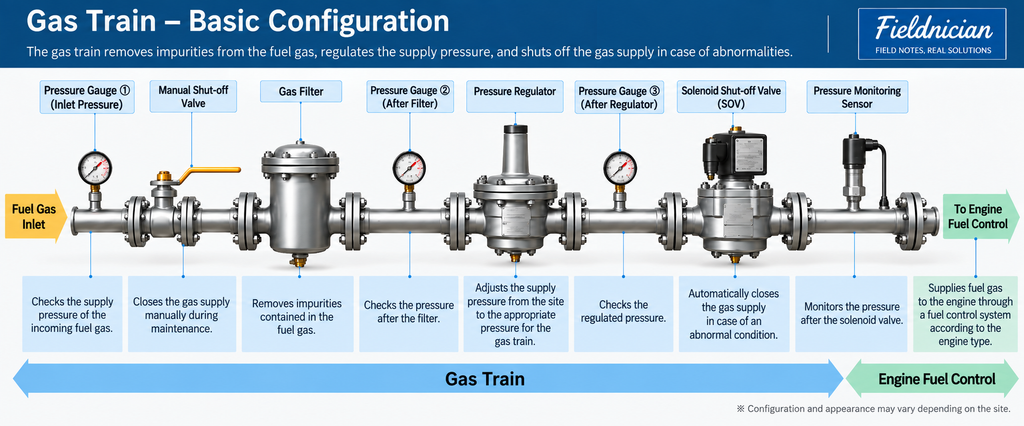
Depending on the engine and installation, the gas train may include:
- Isolation valves
- Gas filters
- Pressure-regulating equipment
- Gas valves
- Flow-control devices
- Pressure sensors and other instruments
A gas filter reduces the amount of solid contamination reaching the valves and control equipment.
Pressure-regulating equipment adjusts the fuel-gas pressure to a range suitable for the engine. Shutoff devices can stop the gas supply when an abnormal condition is detected, while control devices regulate gas flow according to operating conditions.
However, gas-train arrangements and control methods are not identical in every installation.
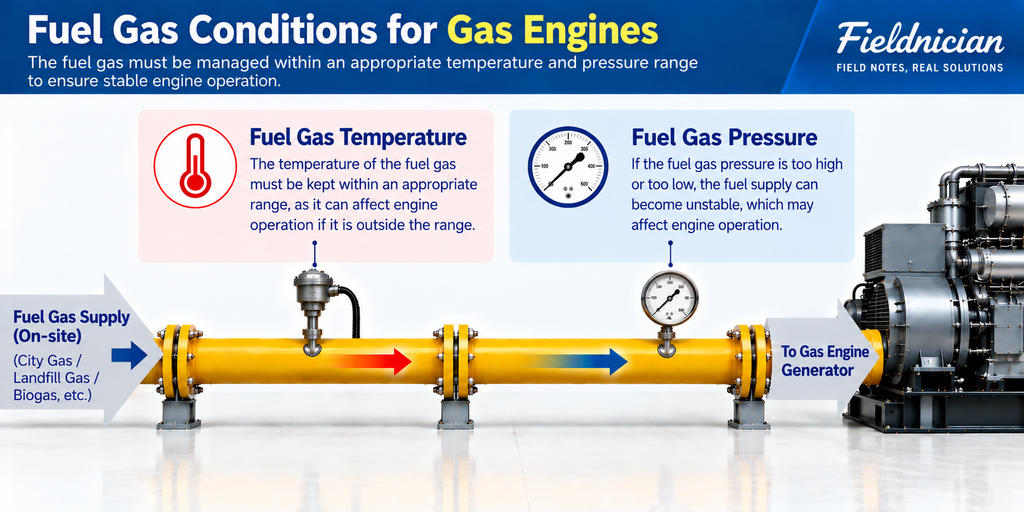
Before interpreting a pressure reading, the location of the sensor or pressure gauge should be identified.
Pressure measured upstream or downstream of the gas train, across a gas filter or valve, or near the gas mixer may represent different operating conditions.
Rather than checking only the current value, it is helpful to compare the pressure when the engine is stopped, during startup, and under different loads with normal operating data.
Related article|Why Is Fuel Gas Supply Important in a Gas Engine?
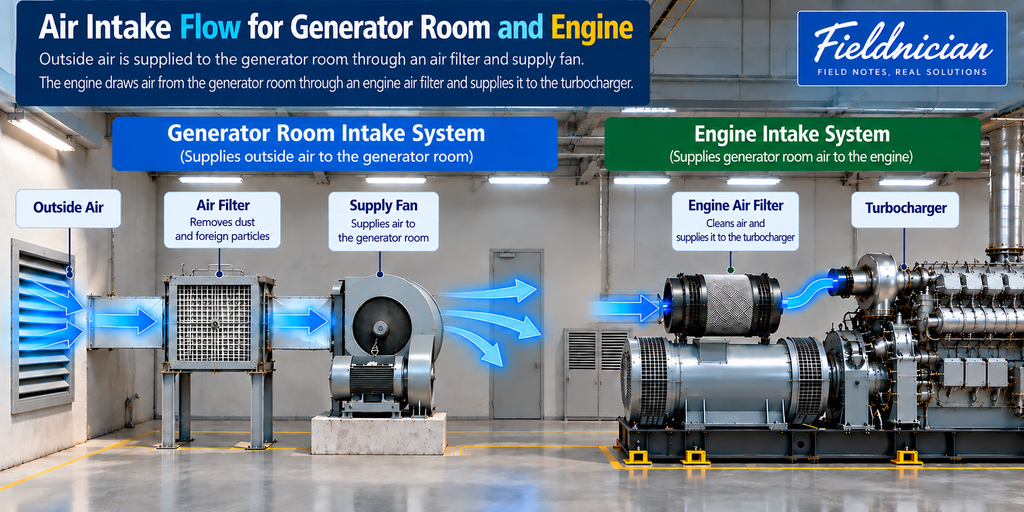
3. Engine-Room Ventilation and Engine Air Intake Are Different
An indoor gas engine installation may use an air-supply system to bring outside air into the engine room.
Air entering the engine room may be used for engine combustion, but it also supports room ventilation and helps remove heat released by the engine and generator.
If an air inlet or filter becomes restricted, or if the supply fan loses performance, the volume of air entering the engine room may decrease.
When an engine draws its combustion air from inside the room, insufficient room air supply can affect both the engine intake condition and the engine-room temperature.
However, the path that supplies air to the engine room and the path through which the engine draws combustion air are not necessarily the same.
Some installations supply combustion air directly from outside through a dedicated intake duct.
Engine-room ventilation and the engine intake system downstream of the air filter should therefore be identified and inspected separately.
4. What Does the Engine Air Filter Do?
Combustion air generally passes through an air filter before entering the engine intake system.
The air filter reduces the amount of dust and other contamination entering the intake system and the engine.
As contamination accumulates, airflow resistance across the filter may increase and restrict the amount of combustion air available to the engine.
The condition of an air filter should not be judged only by its external appearance.
Where measurements are available, the pressure or differential pressure across the filter, boost pressure, and other intake-related operating data can be compared with normal values.
Pressure at one location and differential pressure between two measurement points have different meanings. The measurement locations should therefore be confirmed before the values are interpreted.
After replacing an air filter, the filter installation and intake-pipe connections should be checked for looseness, incorrect assembly, and possible leakage.
5. Where Are Fuel Gas and Air Mixed?
The point at which fuel gas and air are mixed is not the same in every gas engine.
In some of the premixed gas engines I have worked with, the fuel gas and air were mixed upstream of the turbocharger.
The mixture was compressed by the turbocharger compressor, cooled in a fuel mixture cooler, and then supplied to the cylinders through the intake manifold.
The basic flow was as follows:
Fuel gas and air
→ Mixing
→ Boosting by the turbocharger
→ Cooling in the fuel mixture cooler
→ Intake manifold
→ Cylinders
In other engine designs, air may be compressed and cooled before the fuel gas is added.
Some engines may supply fuel gas at the intake ports or at a point closer to the cylinders.
The arrangement of the mixer, throttle valve, turbocharger, and cooler can also vary with the engine design.
A mixing arrangement found on one engine should therefore not be assumed to apply to every gas engine.
The actual mixing point and supply path should be confirmed using the fuel-gas and intake-system diagrams and the engine manufacturer’s technical information.
Related article|How Does a Gas Engine Turbocharger Work?
Related article|The Role of a Gas Engine Intercooler and What to Inspect
6. How Does the Mixture Reach the Cylinders?
After the fuel gas and air are mixed, the mixture travels through the intake system and intake manifold to each cylinder.
Depending on the engine design, a throttle valve may control the amount of mixture supplied to the cylinders.
When engine load increases, more power is required. The control system therefore adjusts the amount of fuel gas, air, or mixture delivered to the engine.
The components used to regulate the supply and engine output vary according to the engine design and control strategy.
Changes in the pressure or temperature of the boosted mixture can affect the amount entering the cylinders and the resulting combustion condition.
Before interpreting mixture pressure or temperature, the location of the sensor should be identified.
A value measured where only air is flowing can have a different meaning from a value measured after fuel gas has been added.
The ratio of fuel gas to air can also affect engine output, combustion stability, and exhaust gas temperature.
A mixture that is too rich or too lean may become unstable, but the correct mixture range is not the same for every engine.
Lean-burn gas engines are specifically designed to operate with excess air. Mixture condition should therefore be assessed using the manufacturer’s specified range and the engine’s normal operating data.
The mixture supply condition can be assessed by comparing engine load, boost pressure, mixture temperature, lambda, and the exhaust gas temperature of each cylinder.
The available sensors and operating data vary among engines, and a mixture-supply problem should not be diagnosed from a single value alone.
Related article|How Does Mixture Boost Pressure Affect a Gas Engine?
7. Follow the Supply Paths During Field Inspection
The condition of the fuel gas and air supply should not be judged from a single instrument reading.
A basic inspection sequence can be organized as follows:
Check the fuel-gas supply path
→ Check the engine-room air supply or outside-air intake
→ Check the engine air filter and intake piping
→ Identify where fuel gas and air are mixed
→ Check mixture pressure and temperature
→ Compare engine load and combustion condition
On the fuel-gas side, confirm that the gas is being supplied at the pressure and conditions required by the engine.
Even when fuel-gas pressure remains normal, changes in gas composition or heating value can affect engine output and combustion at the same flow rate.
The gas composition, heating value, and condition of the gas-treatment equipment may also need to be checked, depending on the fuel being used. Fuel quality and gas treatment will be covered separately in a related article.
On the air side, inspect the engine-room air supply or dedicated outside-air intake, engine air filter, and intake piping for restrictions and leakage.
A leak in the intake piping can prevent the required quantity of air or mixture from reaching the engine.
A leak in piping that carries a premixed charge of fuel gas and air presents a different hazard from an ordinary air leak and must be inspected according to the safety procedure for that engine.
After the fuel gas and air have been mixed, compare boost pressure, mixture temperature, lambda, and cylinder exhaust gas temperatures with engine load.
Detailed fault causes should be investigated in the related articles covering the fuel-gas, intake, and boost systems.
Related article|How Should Gas Engine Intake and Boost-System Problems Be Inspected?
8. Safety Precautions During Inspection
Fuel-gas and premixed-charge systems may retain combustible gas and pressure even after the engine has stopped.
Before dismantling piping, valves, or mixture-system components, isolate the fuel gas supply, prevent unintended gas admission or engine restart, and safely remove the remaining pressure and gas.
Ventilate the system according to the approved procedure and verify the gas concentration with an approved gas detector before beginning work.
Gas leakage should be checked using an approved detector or another method permitted by the site. A flame must never be used to search for a gas leak.
Work that could create a flame, spark, or another ignition source must not begin until ventilation and gas testing have been completed.
After inspection or maintenance, check the leak-tightness of the connections, valve positions, and the assembly of any components that were removed.
Fuel gas should then be restored and the engine returned to operation according to the manufacturer’s requirements, the system diagrams, and the site’s gas-safety procedure.
Conclusion
Fuel gas and air enter a gas engine through separate systems.
Fuel gas passes through the site gas supply system and gas train. Depending on the installation, combustion air may enter through the engine room or a dedicated outside-air duct before passing through the engine air filter and intake system.
The point at which the fuel gas and air are mixed, and whether mixing takes place before or after turbocharging, depends on the engine design.
In some of the premixed engines I have worked with, the fuel gas and air were mixed before the turbocharger and then supplied to the cylinders after boosting and cooling.
During field inspection, the fuel-gas and air paths should be followed using the system diagrams. Pressure, temperature, engine load, and combustion data should then be compared at the appropriate points in the system.