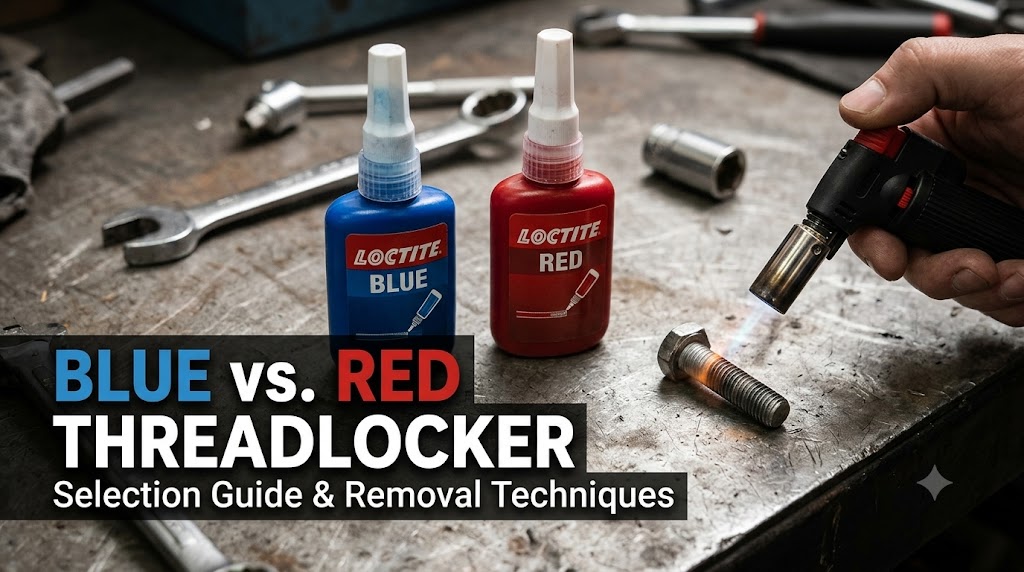
When maintaining industrial equipment, gas engines, or heavy machinery, securing fasteners against vibration is critical. Anaerobic adhesives, commonly known as threadlockers (with Loctite being the most recognized brand), prevent bolts from vibrating loose and seal threads against galvanic corrosion and galling.
However, applying the wrong grade of threadlocker can turn a simple maintenance task into a nightmare of snapped bolts and ruined tapped holes. Understanding the exact mechanical differences between blue and red threadlocker is the first step to proper fastener management.
1. Blue Threadlocker (Medium Strength)
Blue threadlocker (such as Loctite 242 or 243) is designed for medium-strength threadlocking. It is the industry standard for general-purpose maintenance.
- Removability: Fasteners secured with blue threadlocker can be disassembled using standard hand tools without specialized equipment.
- Fastener Size: Ideal for 1/4″ to 3/4″ (6mm to 20mm) bolts and nuts.
- Common Applications: Valve cover bolts, water pump housing bolts, bracket mountings, and components that require routine inspection or replacement.
- Oil Tolerance: Upgraded versions like 243 offer oil tolerance, meaning they can cure even if the threads are slightly contaminated with cutting fluids or motor oil.
2. Red Threadlocker (High Strength)
Red threadlocker (such as Loctite 271 or 262) is engineered for permanent, high-strength assembly. It creates a bond that often exceeds the sheer strength of the fastener itself.
- Removability: Cannot be removed with standard hand tools at room temperature. Forcing a bolt secured with red threadlocker will typically result in rounding the bolt head or snapping the shank.
- Fastener Size: Recommended for heavy-duty fasteners larger than 3/4″ (up to 1″ or 25mm).
- Common Applications: Suspension components, heavy equipment track bolts, bearing mounts, and internal engine studs that should never vibrate loose.
💡 Before you apply: Applying any threadlocker to the wrong bolt grade can lead to snapped fasteners. Check our guide on “How to Identify Bolt Thread Pitch and Grade Markings” to verify your hardware limits. (Coming Soon)
3. How to Apply Threadlocker Correctly
Threadlockers are anaerobic adhesives, meaning they only cure in the absence of air and the presence of active metal ions (like iron, steel, or copper).
- Clean the Threads: Use a degreaser or brake cleaner to remove grease, dirt, and old adhesive from both the male and female threads.
- Apply to the Engagement Zone: Do not coat the entire bolt. Apply a single drop to the specific threads that will engage with the nut or blind hole.
- Allow Proper Curing Time: While fixture time is usually under 20 minutes, a full structural cure takes 24 hours at room temperature.
4. Professional Techniques for Removing Red Threadlocker
If you encounter a bolt locked with red threadlocker, applying excessive breaker-bar torque will only cause damage. The only approved method to break the chemical bond is localized heat.
- Apply Localized Heat: Use a heat gun, propane torch, or oxy-acetylene torch to heat the nut or the material surrounding the blind hole to approximately 500°F (260°C).
- Watch for Indicators: The adhesive polymer structure breaks down at high temperatures. You will often see a small puff of white smoke or smell a distinct sweet, chemical odor when the bond fractures.
- Disassemble While Hot: Do not wait for the component to cool down, as the threadlocker will re-solidify. Carefully back the bolt out using steady pressure while wearing thermal protection gear.
🔍 Dealing with stripped heads? If you are working with smaller machine screws that cam-out before the adhesive breaks, read “Why Screwdriver Bits Slip: PH vs PZ vs JIS.” (Coming Soon)
5. Common Threadlocker Mistakes to Avoid
- Using on Plastic: Threadlockers attack thermoplastics and can cause stress cracking. Only use them on metal-to-metal assemblies.
- Excessive Application: Applying too much liquid can cause it to migrate into bearings or moving parts, freezing mechanisms that must rotate freely.
📚 [Industrial Tools & Mechanics] Related Maintenance Guides
- 👉 How to Identify Bolt Thread Pitch, Metric vs Imperial, and Grade Markings (Coming Soon)
- 👉 Why Screwdriver Bits Slip: PH vs PZ vs JIS Cam-Out Prevention (Coming Soon)
- 👉 Common WD-40 Mistakes: When to Use Solvent vs Lubricant (Coming Soon)