In the previous article, we looked at how a turbocharger uses exhaust-gas energy to compress air or an air-fuel mixture.
When a gas is compressed by the turbocharger compressor, both its pressure and temperature increase.
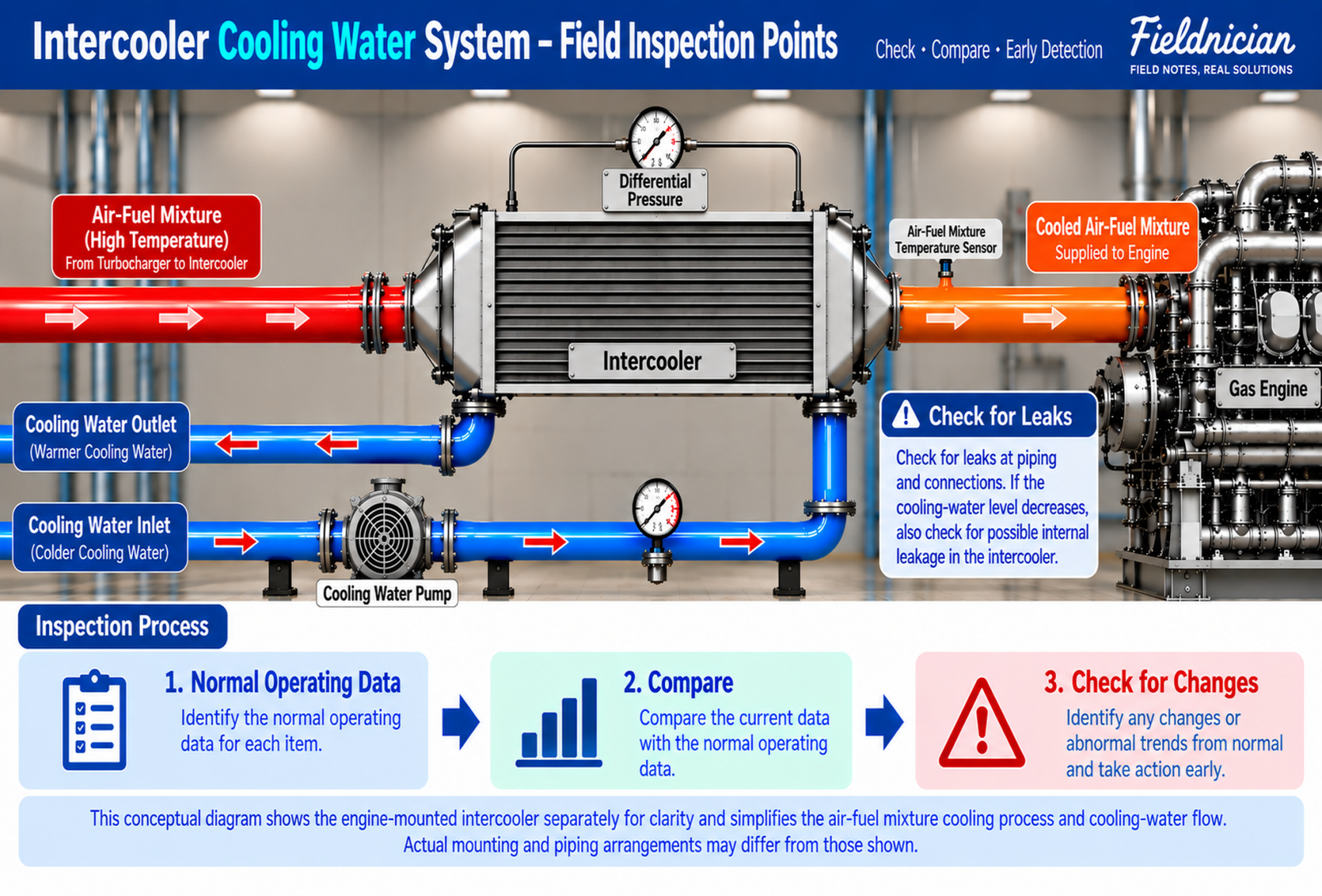
An intercooler lowers the temperature of the compressed air or mixture and helps provide suitable intake conditions for the engine.
A change in intercooler performance can affect the mixture temperature, differential pressure across the intercooler, engine output, and combustion condition.
This article explains how an intercooler removes heat and what should be checked in the field, including temperature, differential pressure, internal fouling, and cooling-water leakage.
Related article | How Does a Gas Engine Turbocharger Work?
1. What Does an Intercooler Do?
When air or an air-fuel mixture is compressed by the turbocharger, its temperature rises.
At the same pressure, a higher-temperature gas has a lower density.. This can reduce the mass of air or mixture contained in a given volume and can also affect engine output, combustion stability, and the margin against knocking.
The intercooler cools the compressed air or fuel-gas/air mixture before it enters the engine.
In some premixed gas engines I have worked with, fuel gas and air were mixed before entering the turbocharger. The compressed mixture was then cooled in the intercooler before being supplied to the engine.
The basic flow was as follows:
Fuel gas and air → Mixing → Boosting by the turbocharger → Cooling in the intercooler → Intake manifold → Cylinders
In this type of engine, the intercooler may also be referred to as a fuel mixture cooler.
In other engine designs, only air passes through the turbocharger and intercooler before fuel gas is added farther downstream.
The fluid passing through the intercooler must therefore be confirmed using the fuel-gas and intake-system diagrams for the specific engine.
2. How Does an Intercooler Remove Heat?
In the water-cooled intercoolers I have worked with, the hot fuel-gas/air mixture and cooling water flowed through separate passages.
The two fluids did not mix directly. Heat moved from the hot mixture to the cooling water through tubes, plates, or other heat-transfer surfaces inside the intercooler.
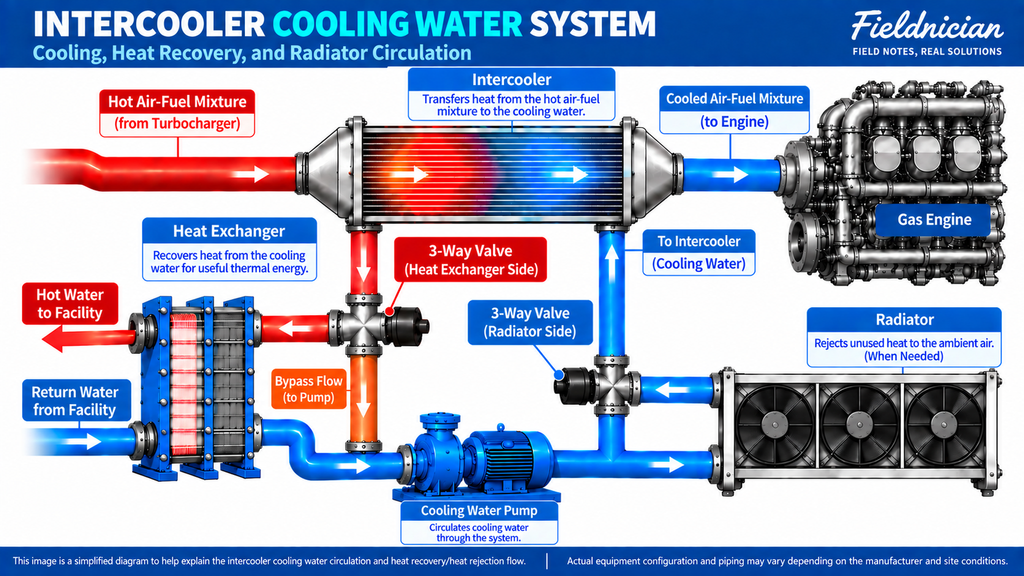
The cooled mixture then moved toward the engine, while the cooling water carried the absorbed heat through the cooling-water system.
Depending on the plant configuration, this heat may be transferred to a heat-recovery system or rejected through a radiator or another cooling device.
Air-cooled intercoolers may also be used in some installations.
The actual cooling-water circuit and heat-rejection or heat-recovery arrangement depend on the engine design and the plant cooling system.
3. What Do the Inlet and Outlet Temperatures Show?
The intake-side inlet and outlet temperatures can be compared to evaluate how much the air or mixture is cooled as it passes through the intercooler.
Under normal operating conditions, the outlet temperature should generally be lower than the inlet temperature.
However, the temperature difference alone does not provide a complete evaluation of intercooler performance.
It can change with:
- Engine load
- Intake mass flow
- Turbocharger compression conditions
- Cooling-water inlet temperature
- Cooling-water flow
- Ambient conditions
For this reason, temperature data should be compared at a similar engine load and under comparable operating conditions.
An outlet temperature that is higher than usual does not always mean that the intercooler itself is damaged. High cooling-water temperature, insufficient circulation, changes in turbocharger operation, or a faulty temperature sensor can produce a similar result.
Excessive cooling can also create problems. If the air or mixture is cooled below its dew point, moisture may condense inside the intercooler or intake piping.
The outlet temperature should therefore be maintained within the operating range specified by the engine manufacturer.
4. What Is the Difference Between Pressure and Differential Pressure?
The inlet and outlet pressures indicate the pressure at each measurement point.
Differential pressure is the difference between the two values:
Differential pressure = Intercooler inlet pressure − Intercooler outlet pressure
When air or an air-fuel mixture passes through the intercooler, a certain amount of pressure loss occurs because of flow resistance.
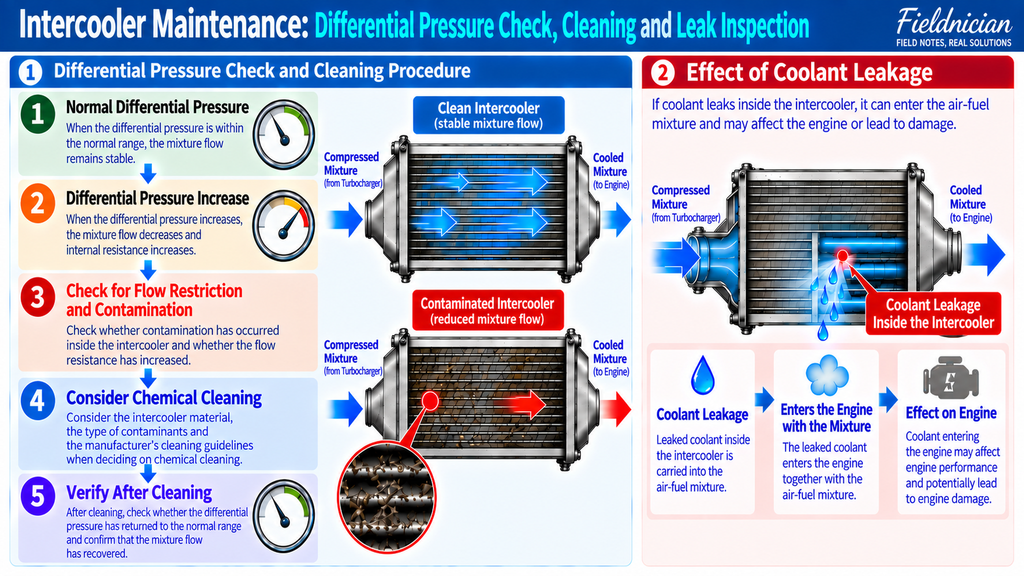
If the differential pressure becomes higher than usual at the same engine load, the resistance inside the intercooler or connected piping may have increased.
Possible causes include:
- Fouling in the air or mixture passages
- A restricted flow path
- Obstruction in the connected piping
- A valve that is not fully open
- A problem with the pressure-sensing lines
- A faulty pressure sensor
Differential pressure also changes with gas flow, density, engine load, and measurement location.
Values measured at different loads should not be compared directly. The inlet and outlet pressures and their differential should be compared under similar operating conditions.
A low outlet pressure alone does not prove that the intercooler is blocked. Turbocharger performance, an upstream air-filter restriction, piping leakage, and engine load can also affect the measured pressure.
5. What Should Be Checked When the Mixture Temperature Is High?
If the mixture temperature downstream of the intercooler is higher than usual, the entire heat-transfer path should be checked before identifying the intercooler as the cause.
First, check the temperature entering the intercooler and the turbocharger operating condition.
Next, check the cooling-water inlet and outlet temperatures, pump operation, valve position, and any part of the system that could affect cooling-water circulation.
Possible causes include:
- High cooling-water inlet temperature
- Reduced cooling-water flow or abnormal circulation
- Fouling or deposits in the cooling-water passages
- Fouling on the air or mixture side
- A change in turbocharger outlet temperature
- A change in boost conditions
- A faulty temperature sensor or wiring problem
Cooling-water pressure should not be treated as the same measurement as cooling-water flow.
A pressure change alone does not prove that the flow is insufficient. The sensor location and cooling-system arrangement must be considered, and temperature, flow, pump condition, and valve position should be compared whenever those measurements are available.
6. How Should Fouling and Cleaning Be Evaluated?
Fouling on the air or mixture side can increase flow resistance and affect the differential pressure across the intercooler.
Oil mist, dust, fuel-related deposits, or other contaminants may accumulate on the gas-side passages and heat-transfer surfaces.
Deposits, scale, corrosion products, or sludge on the cooling-water side can reduce heat transfer and increase the outlet temperature of the air or mixture.
If the differential pressure continues to rise or cooling performance gradually decreases under comparable operating conditions, the internal condition of the intercooler may need to be inspected.
Cleaning should not be performed only because the outlet temperature is high.
Cooling-water temperature and circulation, turbocharger operation, operating load, and instrument readings should first be checked to determine whether fouling is a likely cause.
If chemical cleaning is required, the cleaning agent must be compatible with:
- The intercooler material
- The heat-transfer surfaces
- Gaskets and seals
- The type of contamination
The manufacturer’s cleaning limits and procedures should be followed.
After cleaning, the intake side must be checked to ensure that no cleaning liquid or foreign material remains. The intercooler should be properly dried before it is returned to service.
Temperatures and differential pressure should then be compared with the values recorded before cleaning at a similar engine load.
7. Is Water Inside the Intercooler Always a Coolant Leak?
Water found inside an intercooler or intake pipe does not always indicate cooling-water leakage.
Air naturally contains water vapor. If warm and humid air is cooled below its dew point inside the intercooler, some of that vapor can condense into liquid water.
The amount of condensate can change according to:
- Ambient temperature and humidity
- Intake temperature
- Cooling-water temperature
- Engine load
- Operating duration
However, cooling water can also enter the air or mixture side if a tube, plate, seal, or another internal heat-transfer surface is damaged.
To distinguish condensate from cooling-water leakage, the following should be checked together:
- A continuous decrease in cooling-water level or an increase in makeup-water consumption
- Changes in cooling-system pressure
- An increase in the amount of automatically supplied makeup water
- Color or chemical characteristics of the collected liquid
- Moisture in the piping downstream of the intercooler
- Results of a leak test or pressure test
Condensate and cooling-water leakage have different causes and require different corrective actions. The presence of water alone is not enough to identify the source.
8. Where Can Intercooler Leakage Occur?
An intercooler can develop leakage on the air or mixture side, the cooling-water side, or internally between the two circuits.
An external leak on the air or mixture side may occur at:
- Piping connections
- Flanges
- Gaskets
- Clamps
- Inspection covers
- Intercooler casing joints
A cooling-water leak may appear around cooling-water connections, gaskets, drain points, or the intercooler casing.
If an internal heat-transfer surface is damaged, cooling water may enter the air or mixture passage. It can then move through the intake piping toward the engine.
Depending on the relative pressures of the two circuits, air or mixture may also enter the cooling-water side.
If the cooling-water level or system pressure continues to decrease without a visible external leak, internal intercooler leakage should be considered.
The piping downstream of the intercooler, the engine intake path, exhaust condition, and lubricating-oil condition may also need to be checked.
At sites equipped with automatic cooling-water makeup, a leak may not immediately appear as a low level. The makeup quantity and its trend should therefore be monitored separately.
If a premixed air-fuel charge passes through the intercooler, an external leak can release a flammable mixture. It must not be treated as an ordinary compressed-air leak.
9. What Should Be Checked in the Field?
The intercooler cannot normally be opened during operation to inspect its internal condition.
Its condition must therefore be evaluated by comparing operating data recorded at a similar engine load and under similar conditions.
Important inspection items include:
- Air or mixture temperature at the intercooler inlet and outlet
- Air or mixture pressure at the inlet and outlet
- Differential pressure across the intercooler
- Cooling-water inlet and outlet temperatures
- Cooling-water pressure and circulation condition
- Cooling-water pump operation
- Cooling-water valve position
- External leakage on the air, mixture, and cooling-water sides
- Cooling-water level and makeup quantity
- Engine load and boost pressure
- Related temperature and pressure sensor condition
If the outlet temperature is high, the cooling-water condition, intercooler fouling, turbocharger operation, and temperature sensor should be checked in sequence.
If the differential pressure has increased, the intercooler passages, connected piping, sensing lines, and pressure sensors should all be checked.
A single measurement should not be used to determine the cause. Temperature, pressure, differential pressure, engine load, and operating trends must be considered together.
10. What Safety Precautions Are Required?
Even after the engine has stopped, the cooling-water system may remain hot and pressurized.
Before opening cooling-water piping or intercooler connections, confirm that the temperature has fallen to a safe level and that the internal pressure has been safely released.
Differential pressure across the air or mixture side is meaningful when gas is actually flowing. Measurements taken during operation must be performed without contacting rotating parts, hot surfaces, or pressurized piping.
If a flammable premixed charge passes through the intercooler, the fuel supply must be isolated before the piping or intercooler is opened.
Residual gas must be removed using the approved procedure, adequate ventilation must be provided, and the gas concentration must be confirmed before work begins.
Disassembly, cleaning, leak testing, and pressure testing must follow:
- The engine and intercooler manufacturer’s procedures
- The applicable system drawings
- The site permit-to-work requirements
- The site gas-safety procedures
After maintenance, check the airtightness of the intake or mixture side, the cooling-water connections, valve positions, and instrument connections before restarting the engine.
Conclusion
An intercooler is a heat exchanger that cools air or an air-fuel mixture after it has been compressed by the turbocharger.
Lowering the intake temperature helps provide suitable intake density and supports stable engine output and combustion.
In the field, the air or mixture temperature, cooling-water condition, differential pressure, and leakage should be compared with normal operating data recorded under similar conditions.
Temperature, pressure, and differential pressure represent different conditions and must be interpreted separately.
Water found inside the intercooler is not always caused by cooling-water leakage. Condensate formed under certain operating conditions must be distinguished from an internal leak by checking cooling-water loss, automatic makeup quantity, liquid characteristics, system pressure, and test results.
The intercooler should not be evaluated as an isolated component. Its condition must be considered together with the turbocharger, intake piping, cooling-water system, sensors, and control devices.
Leave a Reply