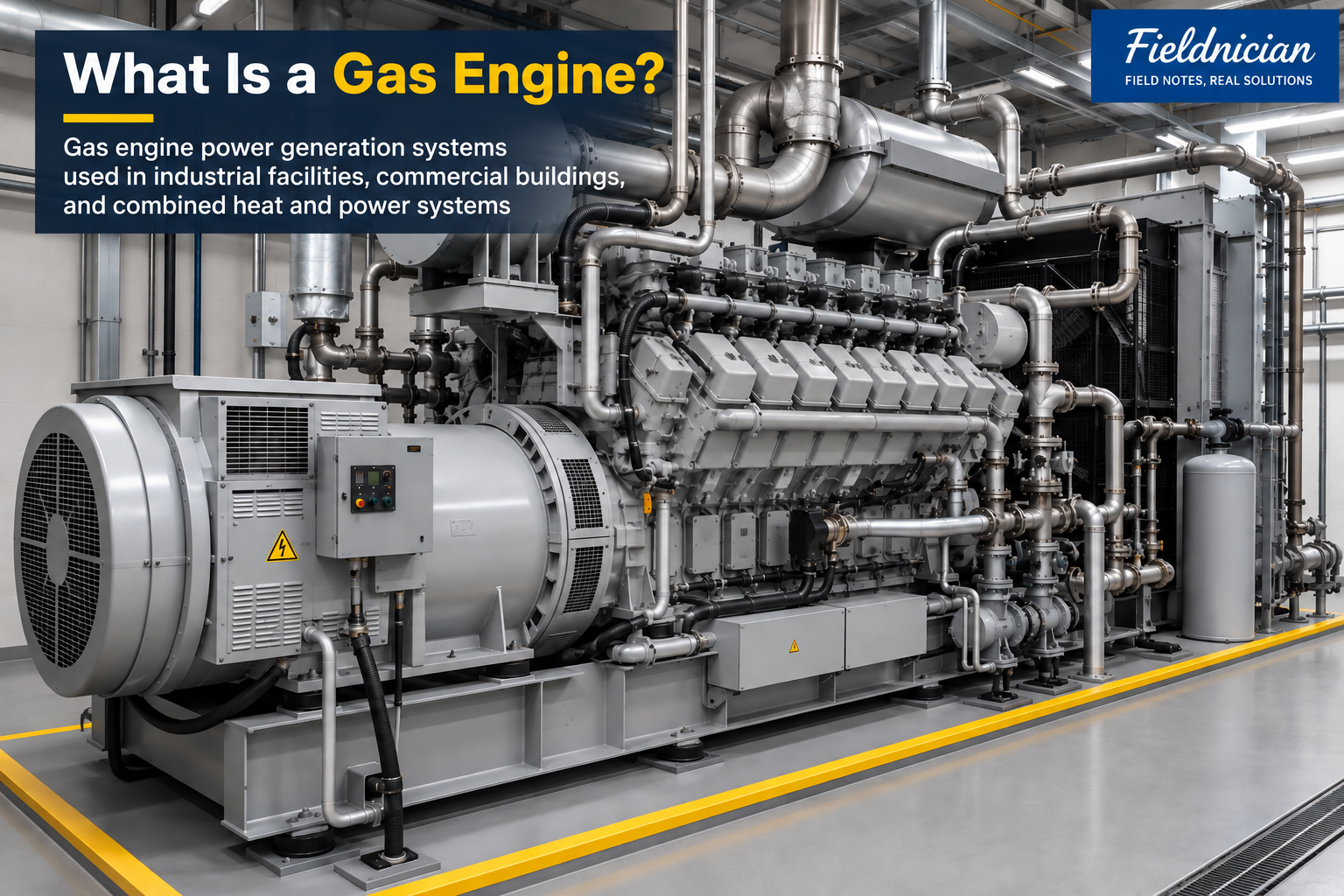
When people think of a generator, they often picture a machine that simply produces electricity. A combined heat and power system, however, does more than that.
A gas engine drives a generator to produce electricity, while some of the heat generated by the engine can also be recovered and used for hot water, space heating, or industrial processes.
When I first encountered a gas engine CHP system in the field, I initially thought of it as an engine connected to a generator. In practice, however, it was a complex installation in which several systems had to operate together.
In this article, we will look at how a gas engine produces mechanical power, how that power is converted into electricity, how heat can be recovered, and what should be checked during operation.
1. What Is a Gas Engine?
A gas engine is a type of internal combustion engine that uses a gaseous fuel such as natural gas, biogas, or landfill gas.
The types of fuel gas that can be used and the required fuel conditions vary depending on the engine. Differences in methane content, heating value, moisture, and impurities may affect the required gas treatment equipment and fuel control method.
In a typical spark-ignited gas engine used for power generation, fuel gas and air are supplied under suitable conditions and ignited inside the cylinders to produce power.
When combustion occurs, the pressure inside the cylinder rises and pushes the piston. The piston’s reciprocating motion is transmitted through the connecting rod and converted into rotary motion by the crankshaft.
The basic energy conversion process can be summarized as follows:
Fuel gas and air → Combustion → Piston movement → Crankshaft rotation
The point at which the fuel gas and air are mixed, as well as the way the mixture is supplied to the cylinders, may vary depending on the engine design.
To keep this process stable, a gas engine requires several supporting systems, including the fuel gas, intake, ignition, cooling, lubrication, and exhaust systems.
Related article|What Is an Internal Combustion Engine? How the Four-Stroke Cycle Works in a Gas Engine (Coming Soon)
2. How Does Engine Rotation Become Electricity?
A gas engine does not produce electricity directly.
The engine converts the chemical energy of the fuel into mechanical rotation. The generator then converts that rotation into electrical energy.
The engine and generator may be connected through a coupling, gearbox, or another type of power transmission system, depending on the equipment design.
As the engine drives the generator, the rotating magnetic field inside the generator induces voltage in the stator windings.
The overall process can be summarized as follows:
Fuel gas and air → Combustion → Engine rotation → Generator operation → Electricity production
The electricity produced may be used by equipment at the facility or supplied while operating in parallel with the utility grid, depending on the site’s electrical system and operating conditions.
Related article|How Is Engine Power Transmitted to the Generator?
Related article|How Does a Generator Produce Electricity?
3. Why Is Heat Recovery Important?
Not all the energy supplied to a gas engine is converted into electricity.
Some of the energy produces mechanical power, while another portion leaves the engine as heat through the cooling water and exhaust gas.
In a power-only installation, this heat may be released through a radiator or another cooling system. In a combined heat and power system, however, useful heat is recovered instead of being discharged entirely to the surroundings.
Jacket cooling water circulates through the engine and absorbs heat from components such as the cylinder heads and liners. This heat can then be transferred through a heat exchanger.
The exhaust gas also contains thermal energy. Depending on the site configuration, some of this heat may be recovered through an exhaust gas heat exchanger.
The basic heat recovery process can be summarized as follows:
Heat from the engine → Cooling water and exhaust gas → Heat exchangers → Usable heat
The recovered heat may be used for space heating, domestic hot water, or industrial processes.
The actual heat sources, heat exchanger arrangement, and final use of the recovered heat depend on the engine, the site configuration, and the facility’s heat demand.
I have encountered gas engine CHP systems installed at department stores, hospitals, apartment complexes, and district energy facilities.
I have also worked at power generation sites using landfill gas and biogas as well as natural gas. Although the installation conditions and fuels were different, the basic purpose remained the same: to make practical use of both electricity and recoverable heat.
Related article|Where Does the Heat from a Gas Engine Go? Understanding Heat Recovery in CHP Systems
4. What Systems Does a Gas Engine Need?
A gas engine operates as part of a system in which several supporting systems are closely connected.
The fuel gas system supplies fuel to the engine at the required pressure and condition. The intake system supplies the air needed for combustion.
Depending on the engine design, a turbocharger may compress air or an air–fuel mixture before it enters the cylinders, while an intercooler reduces its temperature.
The ignition system initiates combustion at the required timing. The jacket cooling system removes and transfers heat from the engine, while the lubrication system reduces friction and wear between moving components.
The exhaust system carries combustion gases away from the engine. Energy remaining in the exhaust gas may also be used to drive the turbocharger or recovered as useful heat.
The engine’s mechanical output is transmitted to the generator, while the control and monitoring systems supervise operating conditions and collect data from each system.
A change in one system may appear as a change in temperature, pressure, combustion condition, or engine output elsewhere.
For this reason, troubleshooting a gas engine requires more than checking an individual component. It is important to follow the complete process from fuel supply and combustion to power generation and heat rejection.
Related article|Main Components of a Gas Engine CHP System and Their Functions
5. What Should Operators Monitor in the Field?
Operating a gas engine involves more than starting the engine and checking its electrical output.
During operation, the following conditions may be monitored:
- Engine load and output
- Engine speed
- Exhaust gas temperature for each cylinder
- Jacket cooling water temperature and pressure
- Lubricating oil pressure and temperature
- Fuel gas pressure
- Intake air or mixture temperature
- Boost pressure
- Ignition-system status and knock data
- Abnormal vibration or noise
- Oil and coolant leakage
Checking whether each value remains within the manufacturer’s specified range is important. However, comparing the current values with normal operating data recorded under similar load and operating conditions can provide a clearer picture of the engine’s condition.
A single instrument reading should not be used to determine the cause of a problem. Operators should identify which value changed first and then compare it with related data from the other systems.
Understanding the relationship between operating values makes it easier to detect small changes before they develop into more serious problems.
6. Why Are Scheduled Inspection and Preventive Maintenance Necessary?
Gas engines used for power generation often operate continuously for long periods.
Even when an engine appears to be operating normally, the condition of its spark plugs, valves, filters, lubricating oil, cooling water, turbocharger, and other components continues to change over time.
My field work has mainly involved scheduled inspections, preventive maintenance, and repairs.
Scheduled inspections are carried out according to the intervals and inspection items specified by the manufacturer. Preventive maintenance involves identifying worn components or deteriorating performance and taking action before a failure occurs.
When a fault does occur, replacing the damaged component is not always enough.
It is also important to determine which operating value changed first and what conditions may have caused the component to fail. This process helps reduce the possibility of the same problem occurring again.
Because an unexpected shutdown of a generating system can affect the operation of an entire facility, maintenance history and normal operating data should be recorded and used during future inspections.
7. What Will Fieldnician Cover?
Fieldnician organizes gas engine structures and operating principles by following the flow of each system.
The articles will cover the basic operating principles of gas engines, the functions of their fuel, intake, ignition, cooling, lubrication, and exhaust systems, and the structure and inspection methods of major components.
They will also explain what should be checked when operating data differs from normal values and how possible causes can be narrowed down by following the related systems.
Based on field experience and technical references, Fieldnician provides practical information that can be applied to gas engine operation, inspection, maintenance, and troubleshooting.
Conclusion
A gas engine burns a mixture of fuel gas and air inside its cylinders. The resulting combustion pressure moves the pistons, and their reciprocating motion is converted into crankshaft rotation.
This mechanical rotation is transmitted to a generator and converted into electrical energy. In a combined heat and power system, heat from the jacket cooling water and exhaust gas can also be recovered and used where it is needed.
A gas engine CHP installation is not simply an engine connected to a generator. It is a complete system in which several supporting systems operate together, and a change in one system can affect the overall condition of the equipment.
In the field, understanding how energy moves from fuel gas to combustion, mechanical power, electricity, and recoverable heat is more useful than simply memorizing component names.
Consistently recording normal operating data and comparing it with current conditions is one of the basic steps in evaluating the condition of a gas engine.
Leave a Reply